


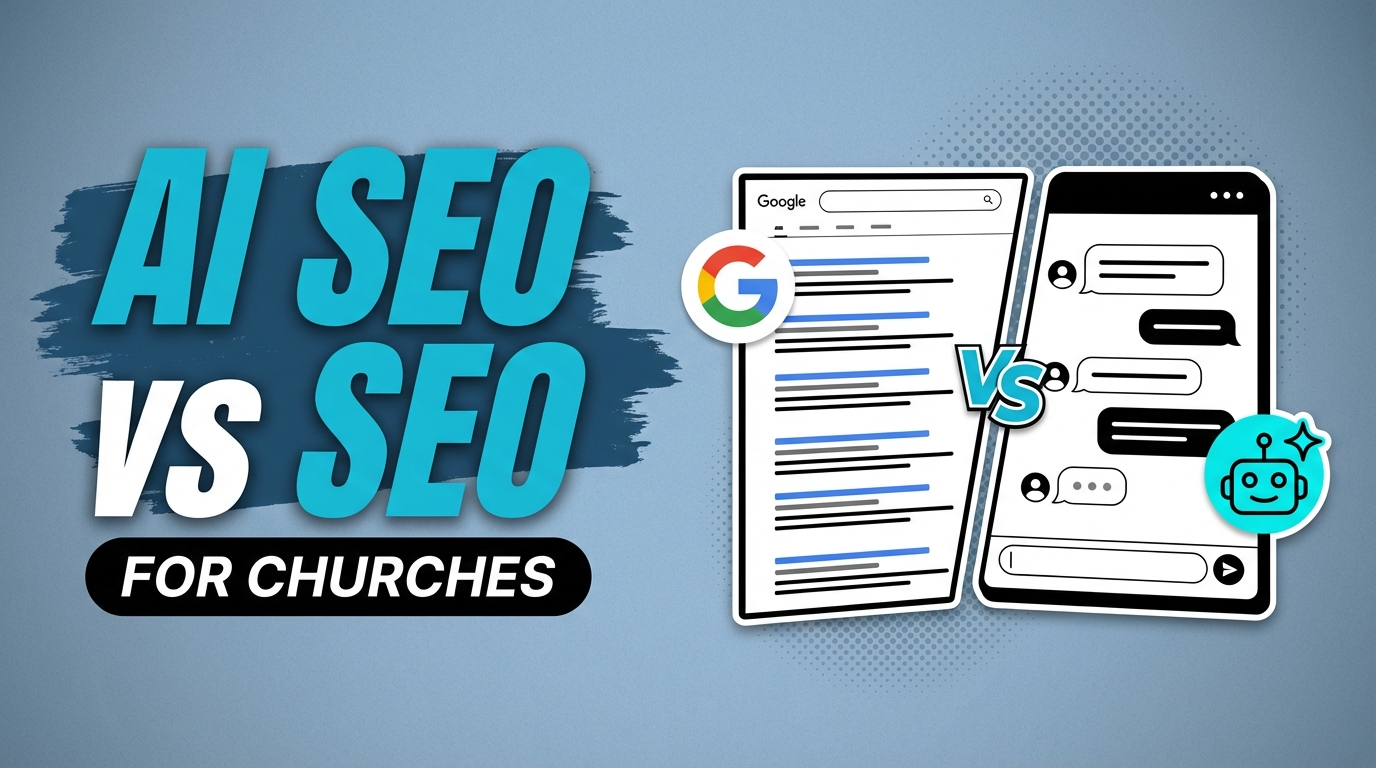
If you’ve been doing SEO for your church, you might be wondering whether AI just made all that work obsolete. Short answer: absolutely not. The longer answer is more nuanced, and it’s worth understanding if you want your church to stay visible online over the next few years.
The conversation around AI SEO vs traditional SEO is generating a lot of noise right now. Some people act like SEO is dead. Others act like AI search is a completely different game that requires starting from scratch. Neither is accurate.
Here’s what’s actually happening, and what it means for your church.
What Traditional SEO Actually Does for Your Church
Traditional SEO is the practice of making your church’s website easy for search engines to find, understand, and rank. When someone searches “churches near me” or “contemporary church in [your city],” traditional SEO is what determines whether your church shows up.
The core components haven’t changed in years. You need a technically sound website, content that matches what people are searching for, and authority signals (backlinks, reviews, citations) that tell Google you’re credible.
For churches specifically, traditional SEO typically focuses on a few key areas:
- Local SEO: Getting your church to show up in Google Maps and local search results for geographic queries like “church in [city]”
- Content SEO: Publishing blog posts, sermon recaps, and resources that rank for questions your community is asking
- Technical SEO: Making sure your website loads fast, works on mobile, and is structured in a way Google can crawl
This is the foundation. Everything else builds on top of it. If you’re not doing the basics of church SEO best practices, AI SEO is irrelevant to you right now.
Traditional SEO has a clear measurement model too. You rank in positions 1-10 on Google’s search results page. People see your listing, read your title and description, and click. The more relevant and compelling your listing, the more traffic you get. It’s a well-understood model that churches have been using successfully for over a decade.
The reason it still works is simple: most people still search the old way. Google processes over 8.5 billion searches per day. The vast majority of those still return traditional search results. Your church’s website still needs to perform well in that environment, regardless of what AI is doing.
What AI SEO Adds to the Picture
AI SEO refers to optimization strategies aimed at appearing in AI-powered search experiences. That includes Google’s AI Overviews (the AI-generated summaries at the top of search results), ChatGPT’s web search results, Perplexity, and other AI tools that pull information directly from websites.
The difference between AI SEO and traditional SEO isn’t the foundation. It’s the output format.
Traditional search serves up a list of blue links. AI search synthesizes information from multiple sources and presents a direct answer, often without the user clicking anywhere. That changes what “winning” looks like.
With traditional SEO, winning means ranking on page one. With AI SEO, winning means being cited as a source inside the AI’s answer, or being the link someone clicks when they want more detail than the AI summary provides.
Think about how you use ChatGPT or Perplexity when you’re doing research. You type a question, get a synthesized answer with a few source citations, and maybe click one or two of those sources for more depth. That’s the behavior AI SEO is trying to influence. You want your church (or your church’s website) to be in the answer, not just in the list below it.
This is sometimes called GEO (Generative Engine Optimization) or “answer engine optimization.” The terminology is new. The underlying goal is familiar: be the source people trust.
For a deeper breakdown of how AI search specifically affects churches, read our full guide on AI SEO for churches.
The Overlap: Where AI SEO and Traditional SEO Are the Same Thing
This is the most important section of this post, and it’s the one most people skip. The overlap between AI SEO and traditional SEO is massive. We’re talking about 80-90% of the same practices.
Here’s what the two approaches share completely:
Content quality is everything. AI systems are trained on high-quality content. Google’s ranking algorithm rewards high-quality content. The same well-written, authoritative, genuinely helpful content that ranks in traditional search is the content AI systems pull from. There is no shortcut version for AI.
E-E-A-T still applies. Experience, Expertise, Authoritativeness, and Trustworthiness are the signals Google uses to evaluate content. AI search engines are doing the same thing. If your church’s website demonstrates that real people with real expertise wrote the content, both systems reward it.
Technical SEO is the baseline. If Google can’t crawl your site, AI systems can’t index it either. Site speed, mobile optimization, proper heading structure, and clean URLs matter for both.
Local signals are critical. For churches, local SEO for churches is the most important SEO work you can do. Your Google Business Profile, local citations, and location-specific content affect both traditional rankings and whether AI systems recommend you for local queries.
Structured data helps both. Schema markup (the code that tells search engines what your content means) helps traditional search with rich results and helps AI systems understand your content structure.
The point is this: if you’re doing traditional SEO well, you’re already doing most of AI SEO. You’re not starting over. You’re building on what you already have.
This is genuinely good news for churches that have been investing in their online presence. The time you spent getting your website right, the blog content you’ve published, the Google Business Profile you’ve maintained: all of it still applies. You’re not behind. You’re positioned to add a layer.
The Differences: What’s Genuinely New
There are real differences between AI SEO and traditional SEO. They’re not as dramatic as the headlines suggest, but they’re worth understanding.
AI systems favor direct answers. Traditional search rewards content that keeps people engaged. AI systems want content that directly answers a question. That means structuring your content so specific questions get specific answers, ideally within the first two or three sentences of a section.
Conversational queries are bigger now. People talk to AI search the same way they’d talk to a person. “What’s a good church for families in downtown Phoenix?” is the kind of query AI handles better than traditional search. Your content needs to match that natural language pattern, not just exact-match keywords.
Brand mentions matter more. In traditional SEO, a backlink (another site linking to yours) is the gold standard. In AI search, brand mentions (another site referencing your church by name, even without a link) also build credibility. Getting your church mentioned in local news, Christian publications, or community resources matters.
Generative Engine Optimization (GEO) is a new discipline. There are specific tactics emerging around getting cited in AI-generated responses, including how you format content, how you structure answers, and how you build topical authority. This is an evolving area. If you want to go deeper, our post on what GEO means for churches covers it in detail.
Zero-click is a real concern. When AI gives a complete answer, users don’t click through. That can affect your traffic even when you’re being cited. It’s a legitimate shift that churches need to plan for by building email lists and other direct channels, not just relying on search traffic.
Topical authority matters more. AI systems don’t just look at individual pages. They look at the overall pattern of content on your site to determine if you’re a credible source on a topic. A church that has published 15 helpful articles about church growth is more likely to be cited on church growth questions than a church that has published one. Consistent, focused content production is now more important than it’s ever been.
A Side-by-Side Comparison
Here’s a practical breakdown of AI SEO vs traditional SEO across the factors that matter most for churches:
| Factor | Traditional SEO | AI SEO |
|---|---|---|
| Primary goal | Rank in Google’s blue links | Get cited in AI-generated answers |
| Key signal | Backlinks and on-page optimization | E-E-A-T, direct answers, brand mentions |
| Content style | Thorough, keyword-optimized | Conversational, question-answer formatted |
| Local impact | Google Maps, local pack | AI local recommendations and named references |
| Technical requirements | Crawlability, speed, mobile | Same, plus structured data and clear site structure |
| Measurement | Rankings, organic traffic | Citations, AI visibility, branded searches |
| Time to results | 3-6 months typically | Emerging, harder to track currently |
| How content is consumed | User clicks to your site | AI summarizes; user may or may not click |
| Schema markup | Helpful for rich results | Important for AI content understanding |
| Church-specific priority | Google Business Profile, local content | Named mentions, FAQ formatting, authority signals |
Looking at that table, the overlap is obvious. The differences are real, but they don’t require abandoning what’s working. They require expanding it.
Should Your Church Focus on AI SEO or Traditional SEO?
Both. But in the right order.
If your church isn’t doing the basics of traditional SEO yet, start there. Get your Google Business Profile optimized. Make sure your website is mobile-friendly and loads fast. Publish content that answers real questions your community is asking. Build local citations. Get reviews.
That is the foundation. AI SEO built on a shaky traditional SEO foundation will not hold.
Once the fundamentals are in place, layer in the AI-specific adjustments. Start formatting content with clear, direct answers. Add FAQ sections to your pages. Build topical authority by publishing consistently within specific subject areas. Make sure your church is being mentioned (not just linked to) in relevant online spaces.
The mistake churches make is chasing AI SEO tactics while neglecting the basics. You don’t need a different strategy. You need a complete one.
A practical starting point: do a quick audit of your current search performance. See where you’re already ranking and where you’re missing. Then identify which AI-specific adjustments would make the biggest difference. Don’t rebuild from zero. Strengthen what you have.
Here’s a simple prioritization for churches at different stages:
If you’re just getting started with SEO: Focus entirely on traditional SEO first. Get your Google Business Profile fully completed. Make sure your website loads in under 3 seconds on mobile. Publish at least one piece of helpful content per month. Build local citations. Get reviews from your congregation. Don’t even think about AI SEO until these basics are solid.
If you have a foundation in place: Start adding AI-specific optimizations. Add FAQ sections to your top pages. Reformat key sections of your blog posts so they give direct answers to specific questions. Start tracking branded search impressions in Google Search Console. Look at whether you’re appearing in Google’s AI Overviews for any of your target queries.
If you’re already ranking well: Layer in GEO tactics. Study which queries trigger AI Overviews in your space. Make sure your church is being cited in those answers. Build topical authority by publishing consistently in focused subject areas. Track mentions (not just links) across the web.
The level you’re at determines where to focus. Most churches we work with are still in stage one or early stage two. That’s fine. The path forward is clear.
The Bottom Line: AI SEO Is SEO Plus
The difference between AI SEO and SEO is not a revolution. It’s an evolution.
AI search requires the same high-quality content, the same technical fundamentals, and the same trust signals that traditional SEO has always required. What’s new is the format of the output and a few specific tactics to optimize for AI citation rather than just ranking position.
For your church, that’s actually good news. If you’ve been investing in SEO, that investment still matters. You’re not starting over. You’re adapting.
The churches that will win in AI search are the same ones winning in traditional search right now: the ones with authoritative, genuinely helpful content written by people who actually know what they’re talking about. That’s not a description of an algorithm play. That’s a description of doing the work.
Start with the fundamentals. Build real authority. Then add the AI-specific layer on top. That’s the sequence that works.
How Visible Is Your Church in Search?
Our free audit checks your local SEO and AI search signals in 60 seconds.
Run Your Free Audit →